

How to Build a Simple Skincare Routine for Beginners
Yes — I’d refine it so the focus keyword “How to Build a Simple Skincare Routine for Beginners” appears naturally in the title, introduction, relevant headings/body sections, and conclusion without keyword stuffing.
For a ~2,000-word article, a practical target is around 0.8–1.2% exact-match usage, meaning roughly 16–24 exact mentions. I’d keep the exact phrase toward the lower end and use semantic variations such as simple skincare routine for beginners, beginner skincare routine, and basic skincare routine throughout.
How to Build a Simple Skincare Routine for Beginners
Starting a skincare routine can feel overwhelming, especially when you’re surrounded by dozens of cleansers, serums, toners, exfoliants, moisturizers, and sunscreens. The good news is that healthy-looking skin doesn’t require a complicated 10-step routine.
If you’re wondering how to build a simple skincare routine for beginners, the answer starts with understanding what your skin actually needs. A beginner-friendly routine should be easy to follow, gentle on the skin, and focused on a few essential steps rather than a bathroom shelf full of products.
For most people, the foundation is simple: cleanse your skin, keep it moisturized, and protect it from the sun. Once you’ve established these basics, you can gradually introduce targeted ingredients according to your skin type and skin concerns.
The goal of learning how to build a simple skincare routine for beginners isn’t to use every trending product. It’s to create a routine that fits your lifestyle, budget, and skin—and that you can consistently follow.
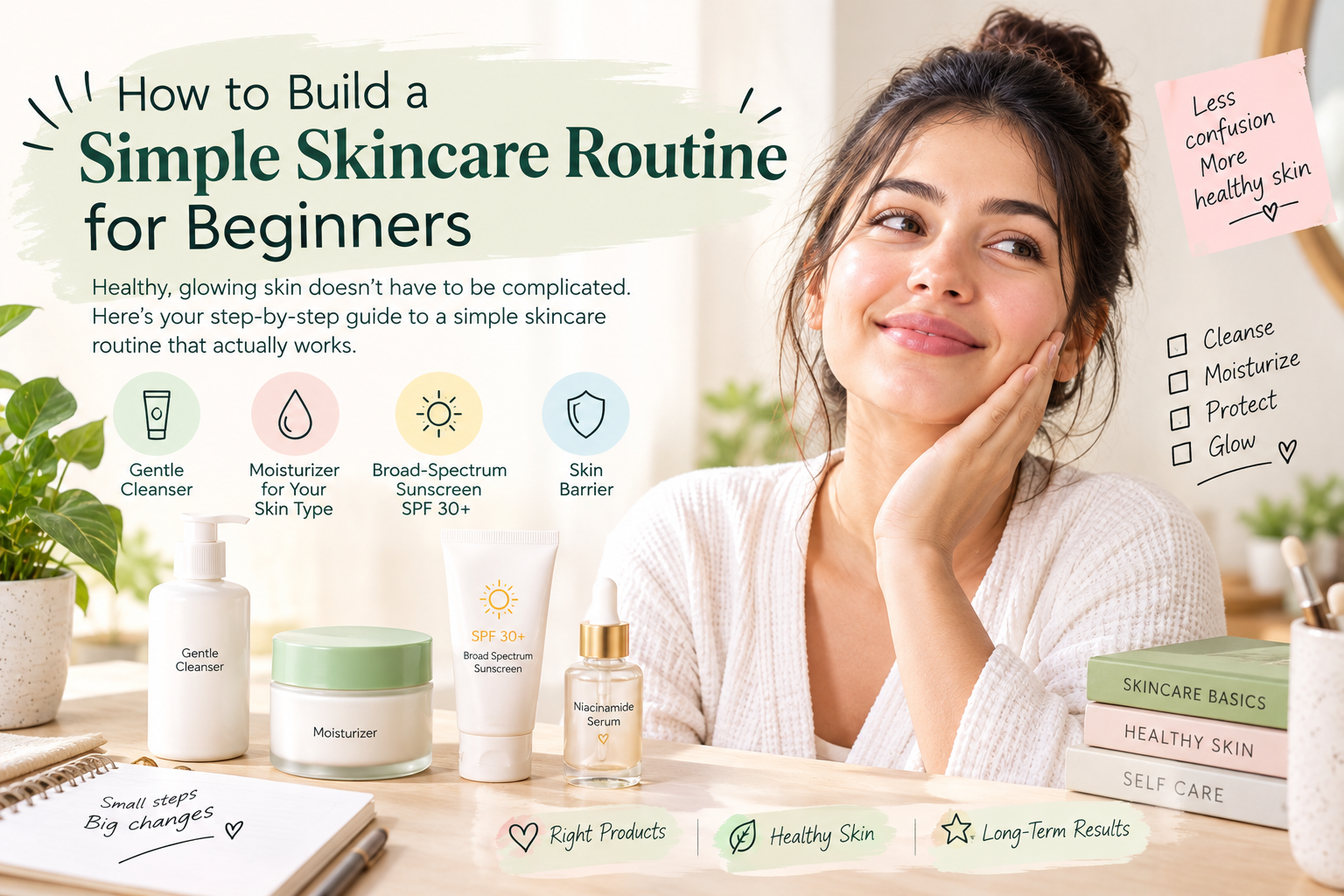
The first step in learning how to build a simple skincare routine for beginners is understanding your skin.
Everyone’s skin behaves differently. A product that works beautifully for one person may leave another person’s skin dry, greasy, or irritated. That’s why identifying your skin type can make choosing skincare much easier.
Common skin types
Normal skin:
Normal skin generally feels balanced, with neither excessive oiliness nor significant dryness.
Oily skin:
Oily skin produces more sebum and may look shiny, particularly around the forehead, nose, and chin. People with oily skin may also experience clogged pores and breakouts.
Dry skin:
Dry skin often feels tight, rough, flaky, or uncomfortable, particularly after cleansing.
Combination skin:
Combination skin typically has more oil around the T-zone while the cheeks may feel normal or dry.
Sensitive skin:
Sensitive skin can react easily to products or environmental changes. Redness, stinging, itching, burning, or discomfort may occur.
Your skin type isn’t necessarily permanent. Weather, age, hormones, stress, medications, and changes in your environment can affect how your skin behaves.
Skin type isn’t the same as skin concern
When figuring out how to build a simple skincare routine for beginners, it’s important to separate skin type from skin concerns.
For example, you might have oily skin with acne, dry skin with pigmentation, or combination skin with occasional breakouts.
Common concerns include:
- Acne and clogged pores
- Dark spots and post-acne marks
- Uneven-looking skin tone
- Dryness and dehydration
- Fine lines
- Redness
- Dull-looking skin
- Sensitivity
Once you understand your skin type and concerns, you can choose products with a specific purpose instead of buying whatever happens to be trending.
2. Start With the Three Essential Skincare Steps
If you’re completely new to skincare, don’t try to build an elaborate routine immediately.
The easiest way to understand how to build a simple skincare routine for beginners is to begin with three fundamental steps:
- Cleanse
- Moisturize
- Protect your skin from the sun
These three steps provide a strong foundation for a beginner skincare routine.
Step 1: Choose a Gentle Cleanser
Cleansing helps remove excess oil, sweat, dirt, sunscreen, makeup, and other impurities from your skin.
However, your face shouldn’t feel painfully tight or “squeaky clean” after washing.
A gentle cleanser is generally a good starting point because it can clean the skin without unnecessarily stripping it.
If you have oily or combination skin, you may prefer a lightweight gel cleanser.
If your skin is dry or sensitive, a creamy or low-foaming cleanser may feel more comfortable.
You don’t need to wash your face repeatedly throughout the day. Excessive cleansing can contribute to dryness and irritation.
For many people, cleansing in the evening is especially useful because it removes sunscreen, makeup, sweat, pollution, and excess oil accumulated during the day.
Step 2: Use a Moisturizer for Your Skin Type
The next essential step is moisturizing.
A moisturizer for your skin type helps keep your skin comfortable and supports its protective barrier.
Oily skin still needs hydration. If heavy creams feel uncomfortable, choose a lightweight gel or lotion.
Dry skin may feel better with a richer cream containing ingredients that help reduce moisture loss.
Combination skin often benefits from a balanced moisturizer that provides hydration without feeling excessively heavy.
For sensitive skin, a simple moisturizer with a relatively straightforward formulation may be preferable.
Why the Skin Barrier Matters
A healthy skin barrier helps protect the skin from external irritants and reduces excessive water loss.
When the barrier is disrupted, you may notice:
- Tightness
- Dryness
- Flaking
- Redness
- Burning or stinging
- Increased sensitivity
One common beginner mistake is using too many active ingredients too quickly.
For example, someone may start using a scrub, exfoliating acid, retinol, acne treatment, and several serums within the same week. Instead of improving their skin, the combination may cause irritation.
A simple routine helps you establish a stable foundation before adding stronger or more targeted products.
Look for Barrier-Supporting Ingredients
When choosing a moisturizer, you may come across ingredients such as:
- Ceramides
- Hyaluronic acid
- Glycerin
- Squalane
- Panthenol
Ceramides are naturally occurring lipids found in the skin and are important components of the skin barrier.
They’re commonly included in moisturizers designed to support dry or sensitive skin.
3. Make Sunscreen a Non-Negotiable Morning Step
If you’re learning how to build a simple skincare routine for beginners, sunscreen deserves special attention.
A broad-spectrum sunscreen SPF 30+ is an important part of daytime skin protection, particularly when you’re exposed to sunlight.
Broad-spectrum sunscreen is designed to protect against both UVA and UVB radiation.
Regular sun exposure can contribute to premature visible skin aging and can make pigmentation and uneven skin tone more noticeable. Consistent sun protection is therefore useful whether your goal is maintaining generally healthy-looking skin, managing pigmentation, or protecting your skin over the long term.
How much sunscreen should you apply?
Use enough sunscreen to adequately cover exposed skin, following the product’s directions. A commonly used guideline for the face and neck is approximately two finger-lengths of sunscreen, although the exact amount can vary by product and application area.
Remember areas that are easily forgotten, including:
- Ears
- Neck
- Hairline
- Around the jaw
- Other exposed areas
Reapply when necessary
Sunscreen doesn’t provide unlimited protection throughout the day.
If you’re spending an extended period outdoors, sweating, swimming, or wiping your face frequently, follow the product’s instructions for reapplication.
Choose sunscreen based on your preferences
The best sunscreen for your routine is one you’re comfortable applying consistently.
Some people prefer lightweight gel formulas, while others prefer fluid, cream, or tinted sunscreens.
If you dislike a product because it feels greasy, leaves a visible white cast, pills underneath makeup, or irritates your eyes, you’re less likely to use it regularly.
When figuring out how to build a simple skincare routine for beginners, practicality matters just as much as the ingredient list.
4. Build Your Morning and Evening Routine
Once you have your cleanser, moisturizer, and sunscreen, putting together your routine becomes much easier.
You don’t need a different product for every step of your day.
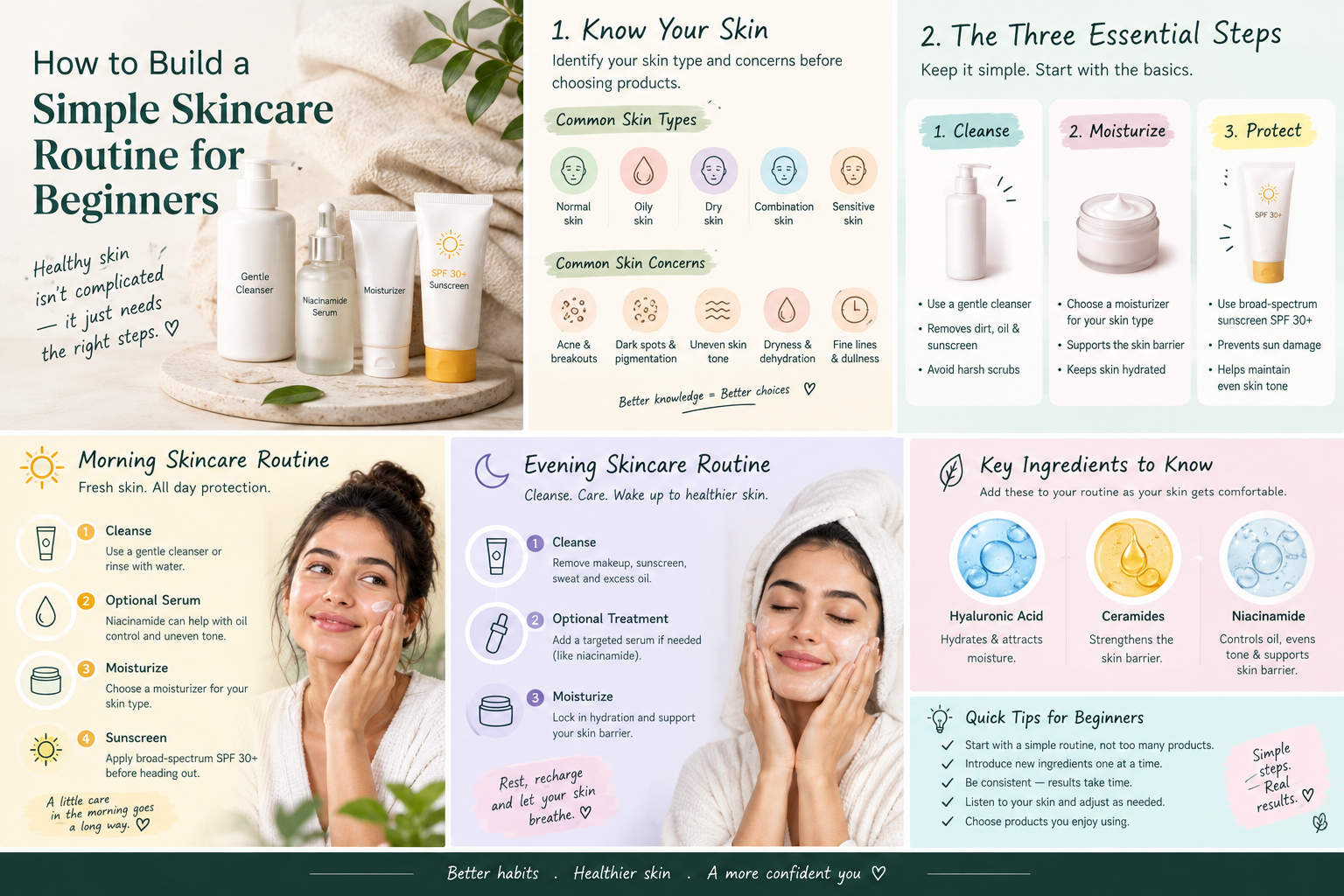
Simple Morning Skincare Routine
A beginner-friendly morning skincare routine can look like this:
Step 1: Cleanse
Use your gentle cleanser if your skin benefits from morning cleansing. If your skin is particularly dry or sensitive, you may prefer simply rinsing with water.
Step 2: Optional serum
Once your basic routine is established, you can introduce a targeted serum if you have a specific reason for using one.
For example, niacinamide is commonly used in skincare products formulated for concerns such as excess oil, uneven-looking skin tone, and supporting the skin barrier.
You don’t need to add niacinamide just because it’s popular. Every product should have a purpose.
Step 3: Moisturize
Apply a moisturizer suited to your skin type.
If your sunscreen already provides enough moisture for your skin, you may prefer using a lighter moisturizer or adjusting the amount.
Step 4: Broad-spectrum sunscreen SPF 30+
Finish your morning skincare routine with broad-spectrum sunscreen SPF 30+, particularly when you’re going outside.
Simple Evening Skincare Routine
Your evening skincare routine can be even more straightforward.
Step 1: Cleanse
Use your gentle cleanser to remove sunscreen, makeup, sweat, excess oil, and daily buildup.
If you’ve worn heavy makeup or water-resistant sunscreen, you may need an appropriate first cleansing step followed by your regular cleanser.
Step 2: Optional treatment
After your skin has adjusted to the basics, you can introduce a targeted treatment according to your concerns.
Step 3: Moisturize
Finish with your moisturizer to help keep your skin comfortable overnight.
This simple approach is often easier to maintain than a complicated routine with numerous products.
Your basic routine at a glance
| Morning | Evening |
|---|---|
| Gentle cleanser or water rinse | Gentle cleanser |
| Optional treatment | Optional treatment |
| Moisturizer | Moisturizer |
| Broad-spectrum SPF 30+ | — |
If you’re still unsure how to build a simple skincare routine for beginners, start with this table and avoid adding anything else until you’re comfortable with the basics.
5. Introduce Skincare Ingredients One at a Time
Once you’ve followed your basic routine consistently, you can consider adding targeted ingredients.
This is where patience becomes important.
A common mistake is adding several new products at once. If your skin becomes irritated, you won’t know which product caused the problem.
Instead, introduce one new product at a time.
Hyaluronic Acid for Hydration
Hyaluronic acid is a humectant commonly used in skincare products to help attract and retain water.
It’s particularly popular in hydrating serums, lotions, and moisturizers.
If your skin feels dehydrated or tight, a product containing hyaluronic acid may be worth considering.
However, you don’t necessarily need a separate hyaluronic acid serum. If your moisturizer already contains effective hydrating ingredients, adding another product may not be necessary.
Niacinamide for Multiple Skin Concerns
Niacinamide, also known as vitamin B3, is another widely used skincare ingredient.
It can be found in products formulated for concerns involving excess oil, uneven-looking skin tone, and barrier support.
When learning how to build a simple skincare routine for beginners, remember that concentration isn’t everything. A higher percentage doesn’t automatically mean better results.
Start with the product directions and monitor how your skin responds.
Ceramides for Skin Barrier Support
Ceramides are naturally present in the outer layer of the skin and help maintain its barrier function.
They’re frequently found in moisturizers designed for dry or sensitive skin.
Rather than searching for a “miracle” ingredient, think of ceramides as one useful component of a well-formulated skincare product.
Don’t Add Everything at Once
Imagine you’ve just started skincare.
On Monday, you add niacinamide.
On Tuesday, you introduce an exfoliating acid.
On Wednesday, you start retinol.
By Thursday, your skin feels irritated.
Which product caused the problem?
You may not know.
This is why gradual introduction is such an important part of understanding how to build a simple skincare routine for beginners.
Common Skincare Mistakes Beginners Should Avoid
Knowing what not to do is just as important as knowing what products to use.
1. Buying Too Many Products
More products don’t necessarily mean better skin.
Start with your basic routine and only add a product when you have a clear reason.
2. Changing Products Every Few Days
Skincare often requires consistency.
If you change your entire routine every week, it becomes difficult to determine which products are helping or irritating your skin.
3. Skipping Sunscreen
If you’re working on pigmentation or trying to protect your skin from premature visible aging, regularly skipping sunscreen can undermine your overall routine.
4. Over-Exfoliating
Exfoliation may be useful for certain concerns, but aggressive or excessive exfoliation can cause irritation.
If your skin becomes unusually tight, flaky, burning, or sensitive, consider simplifying your routine.
5. Copying Someone Else’s Routine
Your friend’s skincare routine may not be appropriate for your skin.
The same applies to influencer routines.
Someone else may have a different skin type, climate, lifestyle, budget, or set of concerns.
Use other people’s routines for inspiration, not as a formula you must copy.
6. Expecting Immediate Results
One of the most important lessons when learning how to build a simple skincare routine for beginners is patience.
Some products can make skin feel more hydrated relatively quickly, while concerns such as acne, pigmentation, and visible signs of aging can take considerably longer to address.
How Long Does a Beginner Skincare Routine Take to Work?
There isn’t one universal timeline for skincare results.
Hydration and skin comfort may improve relatively quickly, while concerns such as breakouts and uneven pigmentation generally require consistent care over time.
Instead of checking your face in the mirror several times a day, look for gradual changes.
Ask yourself:
- Does my skin feel more comfortable?
- Is there less dryness or tightness?
- Am I experiencing fewer breakouts?
- Does my skin tolerate my products?
- Does my skin look more hydrated?
- Am I consistently using sunscreen?
Taking occasional photographs in similar lighting can also help you notice gradual changes.
The key is consistency rather than constantly searching for the next new product.
Beginner Skincare Shopping Checklist
If you’re starting from scratch, you don’t need to buy everything in one shopping trip.
Start with these essentials:
1. Gentle Cleanser
Choose a cleanser that effectively removes daily buildup without leaving your skin feeling stripped.
2. Moisturizer
Choose a moisturizer for your skin type that leaves your skin comfortable and hydrated.
3. Broad-Spectrum Sunscreen SPF 30+
Choose a broad-spectrum sunscreen SPF 30+ that you enjoy wearing consistently.
4. Optional Hydrating Product
If you want additional hydration, consider a product containing hyaluronic acid.
5. Optional Niacinamide Product
If you have a specific reason to use niacinamide, consider introducing it after your basic routine is established.
6. Barrier-Supporting Moisturizer
If barrier support is a priority, consider a moisturizer containing ceramides and other skin-supportive ingredients.
The important point is that you don’t need every product listed above.
A cleanser, moisturizer, and sunscreen can form the foundation of a simple beginner routine.
Frequently Asked Questions About Building a Beginner Skincare Routine
What is the simplest skincare routine for beginners?
The simplest routine generally consists of cleansing, moisturizing, and daytime sun protection. Once these steps are established, additional products can be introduced according to your skin type and concerns.
What should I apply first in my skincare routine?
Generally, start with cleansing, followed by optional treatments, moisturizer, and sunscreen during the morning. Sunscreen should be the final skincare step before makeup when applicable.
Do beginners need a serum?
No. A serum isn’t automatically necessary. If your basic routine is working well, you don’t need to add one simply because it’s popular.
Can I use hyaluronic acid and niacinamide together?
These ingredients can commonly appear together in skincare routines, but always consider the full formulation and your skin’s tolerance. You don’t need multiple serums unless they serve a useful purpose for your skin.
How many skincare products should a beginner use?
There is no fixed number, but starting with three core products—cleanser, moisturizer, and sunscreen—is a practical approach.
How can I avoid irritating my skin?
Introduce new products gradually, avoid adding several active ingredients simultaneously, and pay attention to signs of irritation. If a product causes significant or persistent irritation, stop using it and seek professional advice when appropriate.
Connect with us
Conclusion: Keep Your Skincare Routine Simple
Learning how to build a simple skincare routine for beginners doesn’t mean memorizing dozens of ingredients or purchasing every product you see online.
Start with the fundamentals.
Understand your skin type and skin concerns. Choose a gentle cleanser, use a suitable moisturizer, and make broad-spectrum sunscreen SPF 30+ part of your daytime routine.
Your morning skincare routine can remain simple, while your evening skincare routine can focus on cleansing and moisturizing.
Once your skin is comfortable with these basics, you can gradually explore ingredients such as hyaluronic acid, ceramides, and niacinamide according to your specific needs.
Most importantly, don’t confuse a complicated routine with an effective one.
If you’re still wondering how to build a simple skincare routine for beginners, remember the basic formula: cleanse, moisturize, protect, and introduce new products slowly.
Give your routine time, pay attention to how your skin responds, and focus on consistency. A skincare routine that you can realistically follow every day is far more useful than a complicated routine that you abandon after a week.
Follow on instagram